Bankrupt Card Game: A Versatile Learning Tool
The Bankrupt Card Game is more than just a fun activity—it's a flexible educational tool that can be adapted to nearly any subject or topic. Originally designed as a classroom activity, this game encourages engagement, critical thinking, and healthy competition. Whether you're a teacher, parent, or trainer, the Bankrupt Card Game can be customized to reinforce learning in a dynamic and memorable way.
How the Game Works
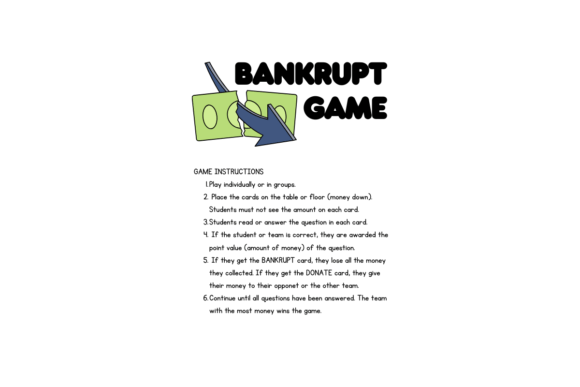
Playing the Bankrupt Card Game is simple and adaptable for different group sizes and learning environments. Each card contains a question or task with a hidden point value. Players or teams take turns selecting cards and answering questions. If they answer correctly, they earn the points on the card. However, if they draw a BANKRUPT card, they lose all their accumulated points. A DONATE card forces them to give their points to an opponent or another team. The game continues until all cards are used, and the player or team with the most points wins.
Why It Appeals to Different Learners
One of the game's biggest strengths is its flexibility. Because the content of the cards can be tailored to any subject—math, science, language arts, history, or even professional training—it's ideal for diverse learning environments. The element of chance introduced by the BANKRUPT and DONATE cards keeps players engaged and adds excitement, making the learning process feel less like a test and more like a challenge.
Practical Uses Across Learning Environments
Teachers have found the Bankrupt Card Game especially useful for reinforcing concepts in a low-stress setting. It works well as a review activity before tests, a warm-up exercise, or a way to break up a long lecture. Beyond the classroom, it can be used in:
- Corporate training to reinforce compliance or product knowledge
- Family game nights to practice trivia or general knowledge
- Language learning to practice vocabulary or grammar
- Small business workshops to engage participants in skill-building exercises
Real-Life Example: Teaching Math Concepts
Imagine a middle school math class reviewing fractions. The teacher creates a set of cards with fraction problems of varying difficulty, each with different point values. Some cards are marked BANKRUPT or DONATE to keep the game unpredictable. Students work in teams to solve the problems, earning points for correct answers. The competitive nature of the game motivates students to think carefully and collaborate, while the risk of losing points adds a layer of excitement that keeps everyone invested.
Benefits for Educators and Trainers
For educators, one of the most appealing aspects of the Bankrupt Card Game is that it can be easily customized. You don’t need special materials—just a set of questions or prompts, a way to assign point values, and a few surprise cards to spice things up. This makes it a cost-effective and reusable resource for any subject or topic. Additionally, the game format encourages participation from students who might otherwise be disengaged during traditional instruction.
Adapting the Game for Different Age Groups
The game can be adjusted for younger children by using visual cards or simple questions, while older students and adults can handle more complex challenges. For example:
- Elementary students: Use picture cards or basic math facts
- High schoolers: Include critical thinking questions or current events
- Professionals: Add scenario-based questions or decision-making tasks
Why I Created a Custom Template
After discovering the Bankrupt Card Game online, I was inspired to create a blank template that teachers could use across subjects and grade levels. The template allows educators to easily insert their own questions and customize the game for their specific needs. This flexibility makes it a powerful tool for reinforcing learning objectives in a fun, interactive way—without requiring hours of preparation.
How to Get Started
If you're new to the Bankrupt Card Game, start small. Create a set of 10–15 cards with questions related to your current topic. Assign point values randomly and include a couple of BANKRUPT or DONATE cards to keep things interesting. As students become more familiar with the format, you can increase complexity, add more categories, or even let students create their own cards.
Important Considerations Before Playing
While the Bankrupt Card Game is adaptable and fun, there are a few things to keep in mind to ensure it's effective and enjoyable:
- Balance difficulty: Mix easy and challenging questions to keep all players engaged.
- Clarify rules: Make sure everyone understands how scoring works and what the special cards do.
- Encourage teamwork: If playing in groups, assign roles so all members participate.
- Monitor pace: Keep the game moving to maintain energy and enthusiasm.
Maximizing the Educational Value
To get the most out of the Bankrupt Card Game, use it as part of a broader learning strategy. Pair it with a lesson, use it as a formative assessment tool, or let it serve as a collaborative review session. The key is to make sure the content aligns with your learning goals while keeping the experience enjoyable and interactive.