Short Vowels Review Game Shark Attack: A Practical Evaluation
Phonics instruction is a foundational element of early literacy, requiring consistent practice and engagement to ensure students master decoding skills. Among the various tools available for educators and parents, the Short Vowels Review Game Shark Attack has emerged as a specific resource designed to target consonant-vowel-consonant (CVC) words. This article evaluates the utility, structure, and applicability of this game, helping readers determine if it aligns with their instructional goals or home learning environments.
Understanding the Short Vowels Review Game Shark Attack
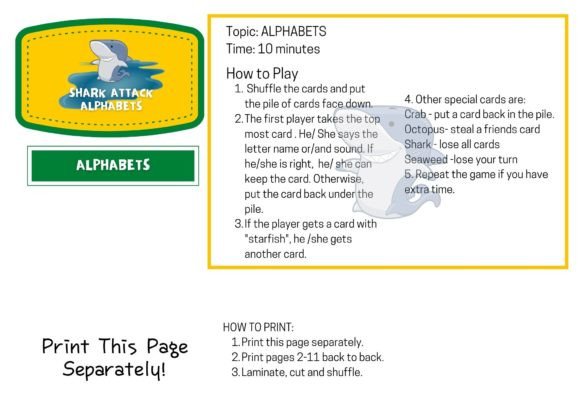
The Short Vowels Review Game Shark Attack is an interactive phonics activity centered on the mastery of short vowel sounds. Unlike broad literacy games that cover multiple linguistic concepts simultaneously, this specific iteration focuses exclusively on the five short vowels: a, e, i, o, and u. The core mechanic involves players identifying CVC words—words where a single vowel is sandwiched between two consonants, such as "cat," "bed," "pig," "hot," and "cup."
The "Shark Attack" theme serves as the narrative framework for the gameplay. Typically, these types of games utilize a visual metaphor where correct answers allow a character to progress safely, while incorrect answers might result in a playful "attack" or reset. This thematic element is designed to maintain student interest during repetitive drills. While it is part of a larger collection of phonics resources covering alphabets, digraphs, diphthongs, and sight words, the Short Vowel version stands alone as a targeted intervention tool for learners who have not yet mastered basic vowel sounds.
Why Consider This Specific Phonics Resource?
Educators and parents often seek resources that address specific gaps in a child's reading development. The primary reason to consider the Short Vowels Review Game Shark Attack is its focused scope. When a student struggles specifically with distinguishing between short 'a' and short 'e', or fails to decode simple three-letter words, a broad curriculum can feel overwhelming. This game isolates the variable, allowing for concentrated practice without the distraction of complex spelling patterns like blends or silent letters.
Furthermore, the gamified nature of the activity addresses the challenge of maintaining attention spans during drill-based learning. Repetition is necessary for muscle memory in reading, but it can become tedious. By wrapping the review in a shark-themed adventure, the game attempts to transform rote memorization into an engaging challenge. For users looking for a standalone solution rather than a comprehensive bundle, this game offers a cost-effective way to target a single, critical skill set.
Benefits and Strategic Advantages
The most significant advantage of the Short Vowels Review Game Shark Attack is its alignment with structured literacy principles. It reinforces the concept that vowels have distinct sounds in closed syllables. By repeatedly exposing students to CVC patterns, the game aids in automaticity—the ability to recognize words instantly without conscious effort. This automaticity is crucial for fluency.
Additionally, the game provides immediate feedback. In a classroom setting, teachers can observe which vowel sounds cause hesitation. At home, parents can use the game as a diagnostic tool to identify whether a child needs more work on short 'i' versus short 'o'. The clear win/loss conditions inherent in the "Shark Attack" format provide tangible milestones for progress, which can be motivating for young learners who thrive on visible achievements.
Another practical benefit is flexibility. Because the content is limited to short vowels, the game can be used in various settings: as a center rotation activity in a small group, a quick warm-up exercise at the start of a lesson, or a brief practice session during remote learning. Its simplicity allows it to fit into tight schedules without requiring extensive setup time.
Tradeoffs and Limitations to Consider
While the focused approach is a strength, it is also a limitation. The Short Vowels Review Game Shark Attack does not cover long vowels, vowel teams, r-controlled vowels, or advanced word structures. If a student has already mastered short vowels, this game will offer little value and may even lead to disengagement due to lack of challenge. It is strictly a remedial or introductory tool, not a comprehensive reading program.
Furthermore, reliance on a single game for instruction can create an unbalanced learning experience. Phonics mastery requires exposure to text in context, not just isolated word recognition. Students must eventually apply their knowledge of short vowels within sentences and paragraphs to develop comprehension skills. Using this game as the sole method of instruction would neglect the broader components of literacy.
There is also the consideration of the thematic elements. While many children enjoy the shark motif, some may find the "attack" aspect stressful or anxiety-inducing. In educational psychology, the balance between challenge and support is vital; if the stakes of the game feel too high, it could hinder performance rather than enhance it. Educators should monitor student reactions to ensure the competitive element remains fun rather than frustrating.
Ideal Scenarios for Implementation
The Short Vowels Review Game Shark Attack is a strong fit for specific educational scenarios. It is particularly effective for:
- Early Intervention: Kindergarten or first-grade students who are struggling to distinguish between similar vowel sounds.
- Small Group Instruction: Teachers working with a subset of students who need extra practice on CVC words while the rest of the class engages in independent reading.
- Home Reinforcement: Parents looking for a short, structured activity to supplement school lessons without purchasing a full curriculum suite.
- Review Sessions: End-of-unit reviews where the goal is to solidify previously taught concepts before moving to more complex patterns.
In these contexts, the game's narrow focus becomes an asset, allowing for deep dives into specific sound-symbol relationships without extraneous information.
When to Consider Alternatives
Despite its benefits, there are situations where alternatives may be more appropriate. If a student is ready to tackle compound words, digraphs (like "sh" or "ch"), or diphthongs, the Short Vowels Review Game Shark Attack will be insufficient. In such cases, a broader phonics game or a leveled reader series would be a better investment of time and resources.
Additionally, if the learner prefers non-competitive activities, the "Shark Attack" mechanic might not be the best choice. Some students respond better to cooperative games or quiet sorting activities. For those seeking a holistic literacy package that includes writing, listening, and speaking components alongside phonics, a comprehensive curriculum bundle would likely yield better results than a single-game purchase.
Finally, if budget constraints are a concern, it is worth noting that while this game is sold individually, purchasing the full collection from the creator's store might offer better long-term value. If a classroom anticipates needing resources for digraphs, sight words, and consonants in the near future, buying them separately later could be less economical than acquiring the complete set upfront.
Decision-Making Insights for Educators and Parents
To determine if the Short Vowels Review Game Shark Attack is the right choice, stakeholders should ask a few key questions. First, does the student specifically need help with short vowel sounds in CVC words? If the answer is yes, this game is a targeted solution. Second, is the goal to isolate and practice one skill, or to introduce a wide range of phonics concepts? If the latter, a broader resource is needed.
Third, consider the learning environment. Does the setting require a low-prep, high-engagement activity that can be deployed quickly? The game fits this description well. However, if the goal is to assess deep comprehension or reading fluency in connected text, this game should be viewed as a supplementary tool rather than a primary assessment method.
Ultimately, the value of the Short Vowels Review Game Shark Attack lies in its specificity. It is not a cure-all for reading difficulties, but it is a precise instrument for addressing short vowel mastery. By understanding its scope and limitations, educators and parents can make informed decisions about integrating it into their literacy strategies, ensuring it serves as a helpful stepping stone toward greater reading independence.