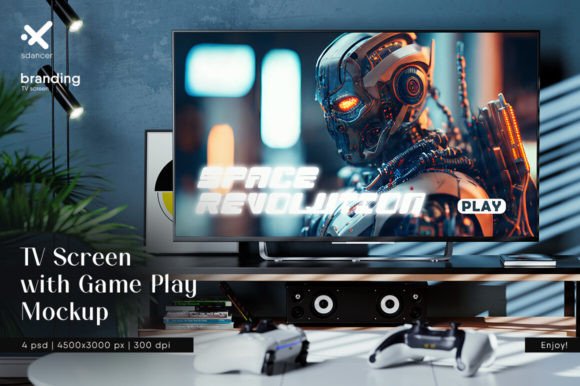
TV Screen with the Game Play Mockup: Elevating Your Visual Presentations
In the competitive landscape of digital design, how you present your work is often just as important as the work itself. Whether you are a game developer showcasing a new title, a marketing agency pitching a campaign, or a UI designer refining an interface, static screenshots rarely capture the full essence of your vision. This is where the TV Screen with the Game Play Mockup becomes an indispensable tool. It transforms flat images into immersive, realistic environments that tell a compelling story to clients, investors, and audiences.
The specific resource known as the TV Screen with the Game Play Mockup offers a sophisticated solution for professionals who need high-fidelity presentations without the steep learning curve of 3D rendering software. By providing four distinct PSD styles in high resolution, this asset bridges the gap between raw concept art and polished final deliverables, allowing creators to focus on their core craft while ensuring their presentation looks professional and industry-standard.
Understanding the Power of Context in Design
At its core, a mockup is a visual representation that places a design into a real-world context. When we discuss the TV Screen with the Game Play Mockup, we are talking about more than just a picture of a television. We are discussing a strategic asset designed to simulate how a game or application will appear on a consumer's screen in their living room.
Designers often face the challenge of conveying scale, lighting, and atmosphere through a simple JPEG. A screenshot of a game level might look vibrant on a monitor, but it fails to communicate how that same image interacts with ambient light, reflections, and the physical bezel of a display. The TV Screen with the Game Play Mockup addresses this by providing a photorealistic container. It adds depth and dimension, helping viewers visualize the end product in a way that feels tangible and authentic.
Overcoming Common Presentation Challenges
Many creative professionals struggle with the "uncanny valley" of presentation. They invest hundreds of hours into perfecting a game scene or a dashboard interface, only to have it dismissed because the presentation looked amateurish. Common challenges include:
- Lack of Realism: Flat images do not convey the excitement of playing a game on a large screen.
- Inconsistent Lighting: Mismatched lighting between the game screenshot and the environment can break immersion.
- Time Constraints: Creating custom 3D renders from scratch is time-consuming and requires specialized skills.
- Client Communication: Clients often cannot visualize the potential of a project based solely on wireframes or raw assets.
The TV Screen with the Game Play Mockup directly addresses these pain points. By utilizing smart objects, the lighting and perspective of the screen automatically adjust to fit your content, eliminating the guesswork. This ensures that every presentation maintains a consistent, high-quality standard, regardless of the complexity of the underlying design.
Key Features That Drive Efficiency
While the visual impact is the primary draw, the technical architecture of this resource is what makes it a practical solution for busy professionals. The package includes four unique PSD styles, each offering a different aesthetic to suit various branding needs. These files are crafted at a massive 4500x3000 pixel size with a print-ready 300dpi resolution. This level of detail ensures that whether the image is viewed on a small mobile device or blown up for a billboard, the quality remains crisp and sharp.
The most significant advantage lies in the ease of editing. The files utilize Smart Objects, a feature in Adobe Photoshop that allows for non-destructive editing. This means you never have to worry about ruining the original file structure. The process is streamlined into three simple steps:
- Open the PSD file: Launch the file in your preferred version of Photoshop.
- Access the Smart Object: Double-click the designated smart-object layer thumbnail in the layers panel. This opens a separate document window.
- Paste or Create Your Work: Simply paste your game screenshot, UI design, or artwork onto this canvas. Once satisfied, save the file and close it.
Upon returning to the main document, your design is instantly warped, lit, and integrated into the TV screen perfectly. No manual masking, blending mode adjustments, or distortion tools are required. This workflow saves hours of tedious labor, allowing designers to iterate quickly and produce multiple variations in minutes.
Practical Applications Across Industries
The versatility of the TV Screen with the Game Play Mockup extends beyond just video game developers. Its applications span across several sectors where visual storytelling is key.
Game Development and Publishing
For indie developers and major studios alike, the press kit is critical. A well-crafted mockup can be the difference between securing a feature on a gaming news site or being overlooked. Using the TV Screen with the Game Play Mockup, developers can showcase gameplay footage in a setting that mimics the player's actual experience. It helps publishers and journalists understand the scope and fidelity of the graphics immediately.
Marketing and Advertising
Agencies frequently need to pitch concepts to clients who may not be tech-savvy. Showing a logo or a website design floating in a void is less impactful than showing it displayed on a modern, sleek television in a cozy living room. The four different styles included in the package allow marketers to match the mood of the brand—whether that is a dark, cinematic look for a thriller game or a bright, clean aesthetic for a family-friendly app.
UI/UX Design Portfolios
Interface designers often struggle to show how their screens look in a connected home environment. By placing their dashboard designs into the TV Screen with the Game Play Mockup, they demonstrate an understanding of user context. It shows that the design isn't just a collection of buttons, but a functional part of a larger ecosystem.
Tailoring the Approach to Different Users
Different users will approach this resource with varying levels of expertise and goals, but the tool adapts to meet them all.
The Freelancer: For the solo freelancer, speed is currency. The organized layers and folders within the PSD files mean there is no time wasted searching for the right element. The ability to swap out designs instantly allows for rapid client revisions. If a client wants to see three different color schemes, the freelancer can deliver three polished mockups in the time it would take to render one manually.
The Agency Team: Larger teams benefit from the consistency provided by the high-resolution standards. With 300dpi output, agencies can use these mockups for both web banners and printed brochures without needing separate assets. The inclusion of a Help file.pdf ensures that even junior team members can utilize the templates correctly, maintaining brand consistency across the entire organization.
The Student or Hobbyist: Even those just starting out can elevate their portfolios significantly. Using professional-grade assets like the TV Screen with the Game Play Mockup signals to potential employers that the creator understands industry standards. It demonstrates attention to detail and a commitment to presenting work in the best possible light.
Important Considerations for Implementation
While the tool is powerful, understanding its limitations and proper usage is essential for the best results. It is important to note that the images used for preview purposes are not included in the download. The package contains the four PSD files and the help documentation, but you must supply your own artwork. This is actually a benefit, as it encourages you to create original content rather than relying on stock imagery.
When inserting your design, consider the aspect ratio of your source material. While the smart object handles the transformation, ensuring your original image has a similar resolution to the target area (or higher) will prevent pixelation. Since the mockup is high resolution, using low-quality screenshots will result in a blurry appearance on the TV screen, negating the benefits of the template.
Furthermore, think about the narrative you want to tell. The four styles likely offer different lighting conditions and angles. Choose the style that best complements the mood of your game or application. A horror game might benefit from a darker, moodier TV setup, while a racing game might look better in a dynamic, action-oriented angle.
Conclusion
In a world saturated with digital content, standing out requires more than just good ideas; it requires excellent presentation. The TV Screen with the Game Play Mockup serves as a bridge between concept and reality, offering a fast, efficient, and professional way to showcase your work. By leveraging high-resolution templates, smart object technology, and organized workflows, designers can overcome common presentation hurdles and deliver visuals that captivate and convince.
Whether you are launching a new game, pitching a marketing campaign, or building a portfolio, investing time in your presentation pays dividends. This resource empowers you to focus on creativity while ensuring your final output looks as polished as the effort you put into the design itself. Embrace the power of context, and let your work shine on the big screen.